Saturday, August 31, 2019

Craco has seen better days

Craco, in Basilicata, has seen better days. In the 11th century, a Norman fortress was built, and in the 1200s there was a university, and later several Palazzos were built. Then there was a plague in 1656 which killed hundreds, and later the town was under Napoleonic rule. And between 1892-1922, more than 1,000 townspeople migrated to North America due to declining agriculture. Then there were landslides in the 1960s, some from natural causes, and some from poorly planned infrastructure projects. An earthquake also contributed to Craco’s downfall.

The end result: Craco is a crumbling ghost town, now known as the backdrop to movies such as Christ Stopped at Eboli, King David, and The Nymph. The only way to see Craco close-up is with a tour; hard hats required. The tour is on foot, and only goes on the exterior, winding, narrow streets since the buildings are too precarious to go inside. 

Here are a few photos that include the Norman Tower and the Cathedral.
Craco, in Basilicata

The Cathedral of Craco

11th century Norman Tower

Craco is surrounded by wheat fields and olive groves


Friday, August 30, 2019

a squared plus b squared equals c squared

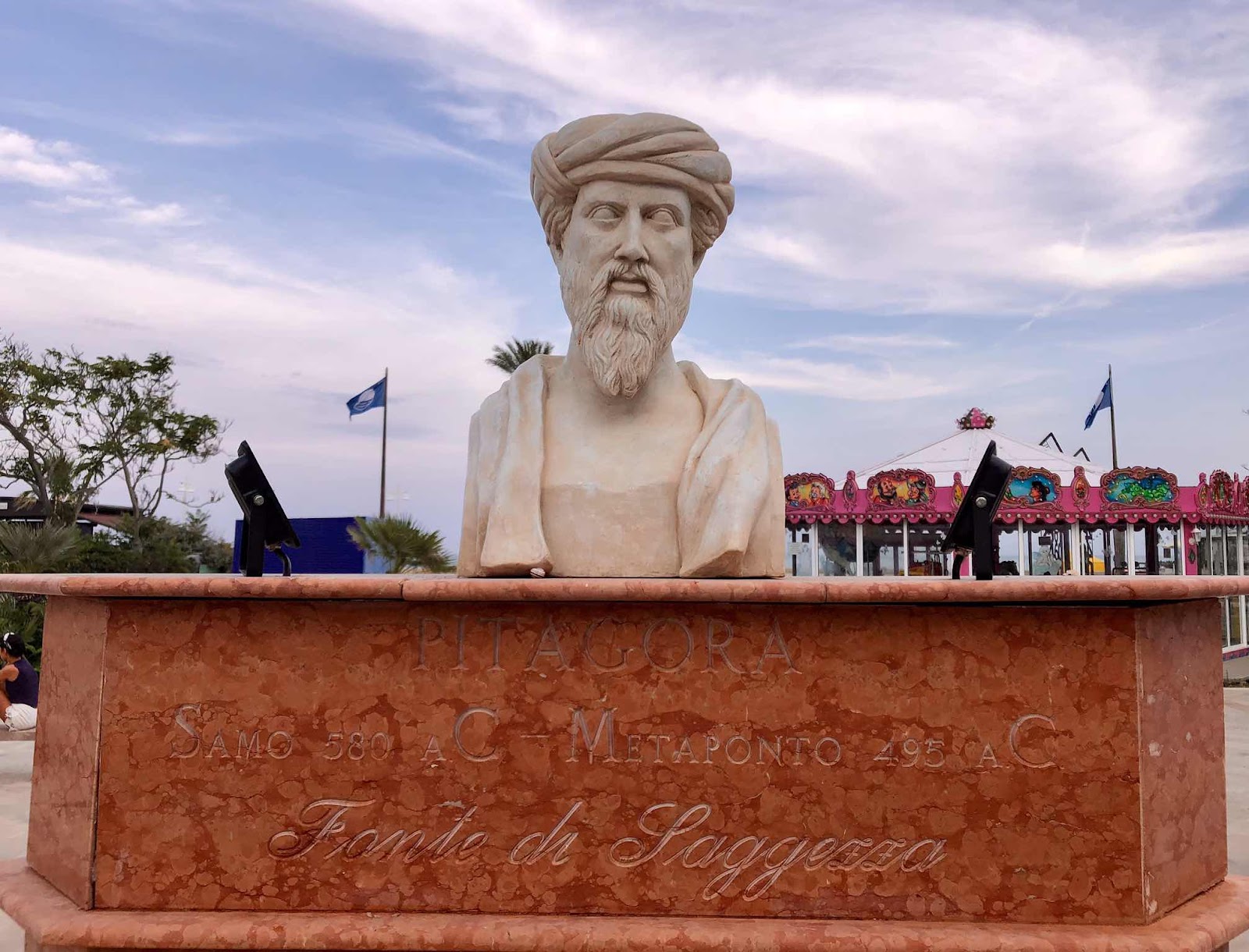
Who among us does not remember this equation from high school geometry? And we also remember that the “c” is the hypotenuse of a right triangle. We have Pythagoras to thank for this formulation, or in Italian, Pitagora. Yesterday was our first day in Basilicata, the region to the west of Puglia. We are in a town on the coast called Metaponto where Pitagora lived the last 15 of his 85 years (580 - 495 BCE).

Pitagora on the main square, Piazza Pitagora


We’ll tour a Greek archeological site today, as well as an archeological Museum here in Metaponto. Yesterday we stopped at the Tavola Palatina to see the ruins of a Greek Temple dedicated to Hera, sister/wife of Zeus and Goddess of Women. Unfortunately, only 15 of the original 32 Doric columns remain, and there is no frieze or tympanum.
 Tavola Palantine, Metaponto, Basilicata


Wednesday, August 28, 2019

Arbor belli...tree of war

After a closer look at the origins of the name of Alberobello, the small town in Puglia, I discovered that the name is derived from arbor belli...tree of war. Seems as if the area, an oak tree forest, was contested between two feudal kingdoms in the 11th century,  and the contested are became known as arbor belli. Alberobello means beautiful tree in Italian, so I’ll go with that.

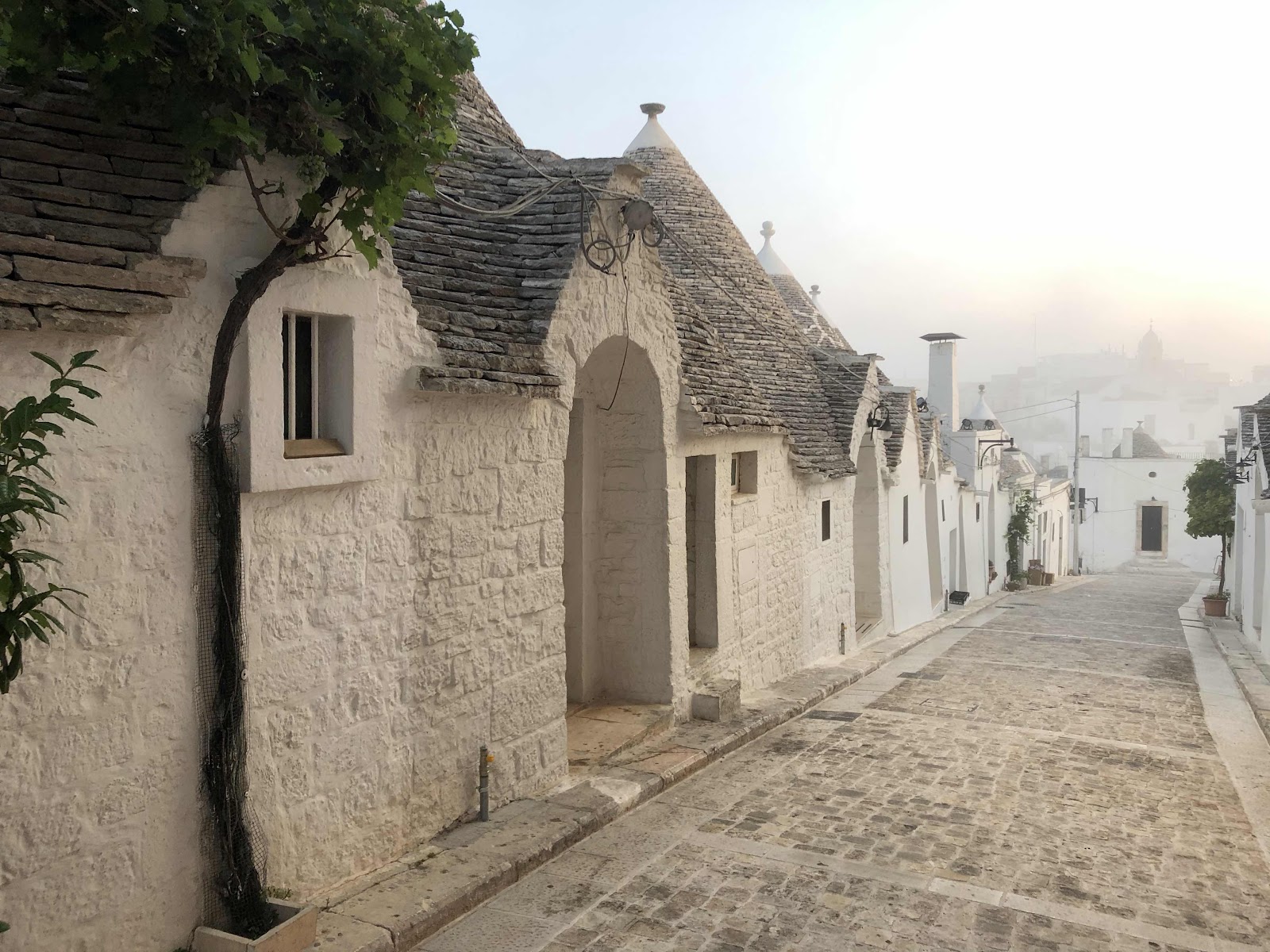
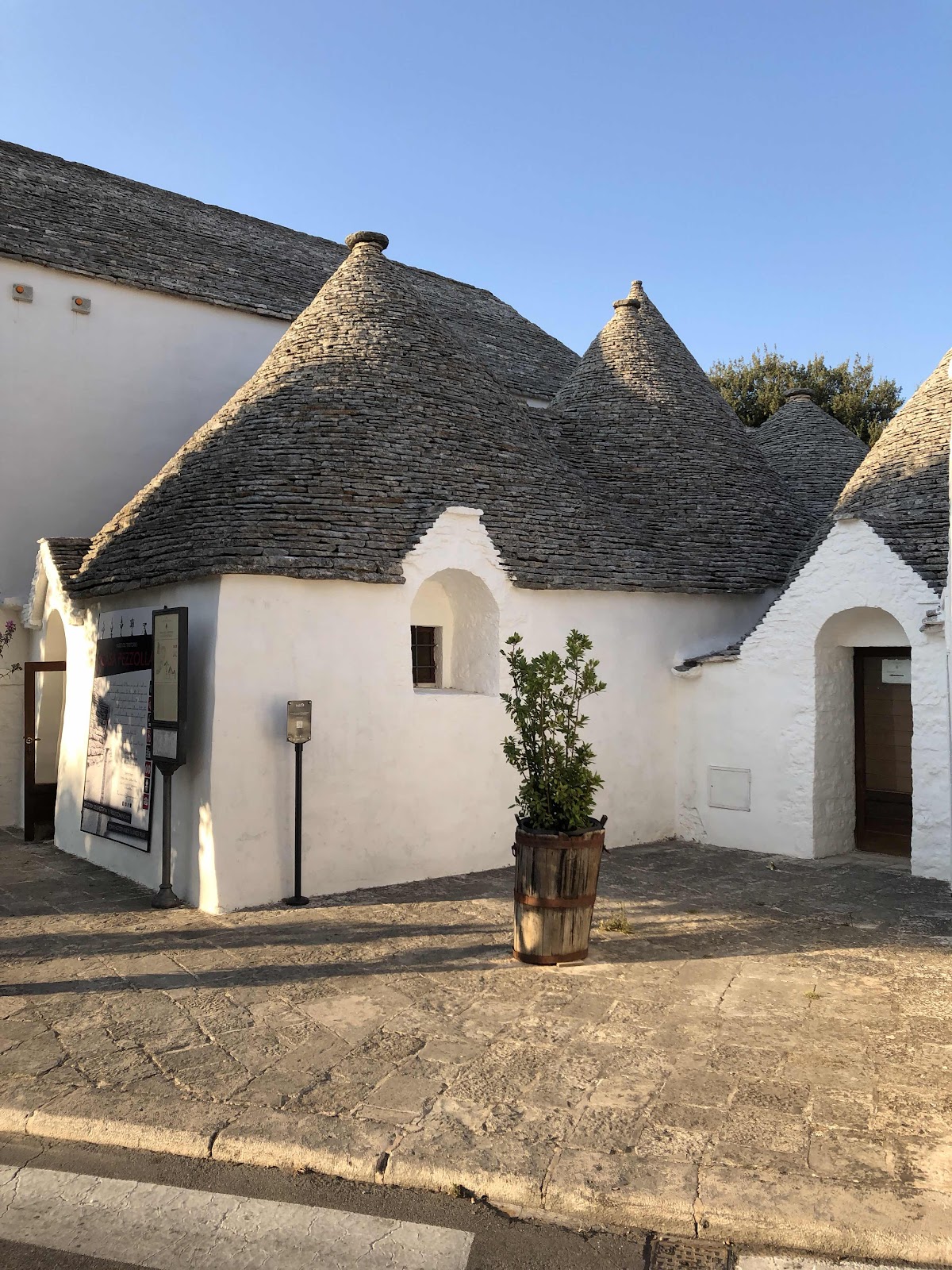
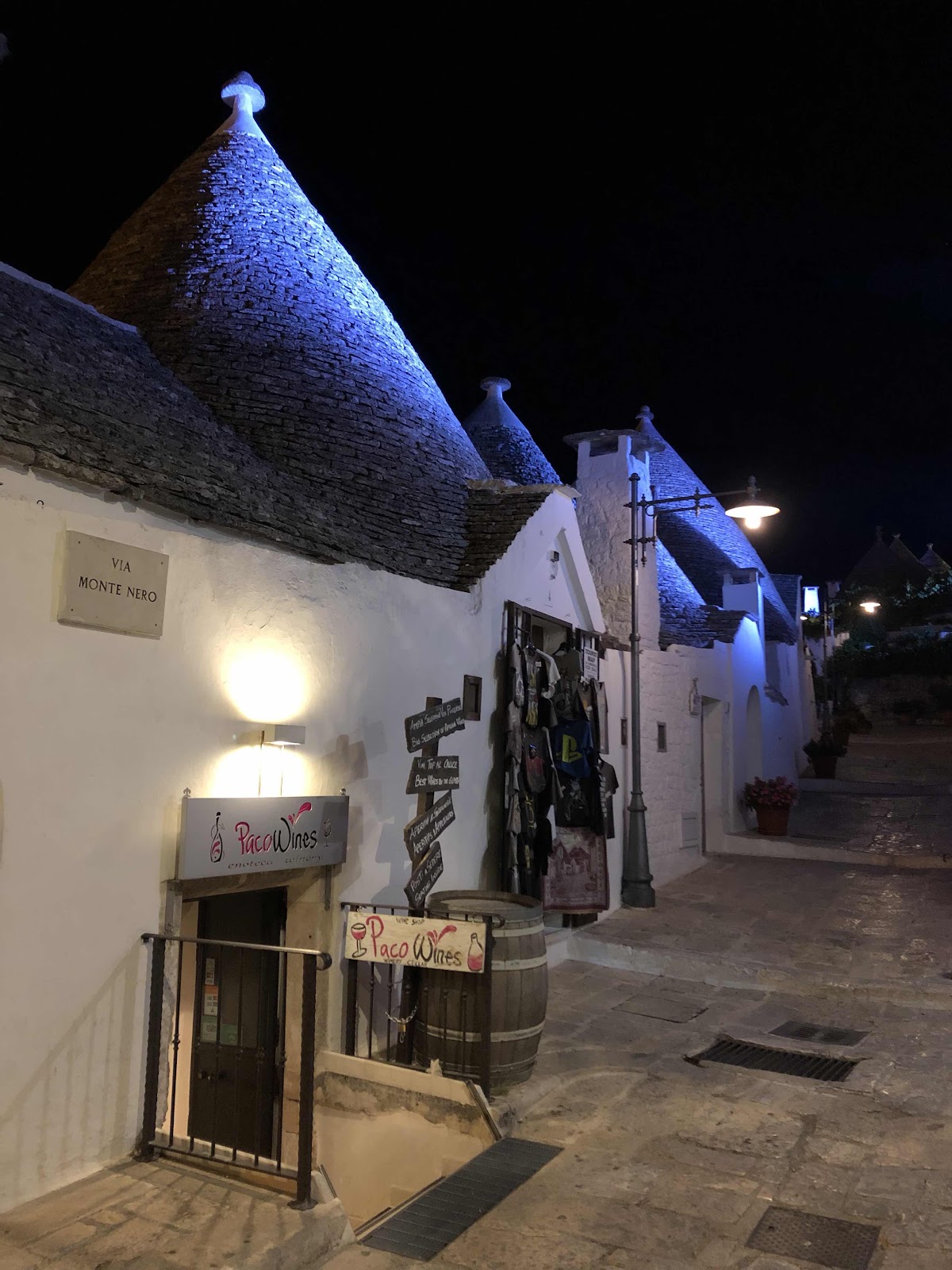
Alberobello is a UNESCO World Heritage site because of its uniquely shaped and constructed houses, the trulli (trullo in the singular). The count who owned the land allowed people to build only temporary houses; building permanent  houses would have required the count to pay taxes to the Spanish rulers in the Kingdom of Naples. The local folks developed a round design for the houses that would be be stable without using mortar. 

Many of the trulli in Alberobello are centuries old, but the walls are strengthened with mortar, and the exterior and interior walls and ceilings are finished with plaster. The roofs still appear to be dry layed without mortar. Our trullo has modern plumbing, electricity, and AC (thankfully since it's been around 90 degrees F). Here’s a photo of our trullo, Trulli delle Sorelle #14.


There are trulli in most parts of the old city, with one area, the Rione AIA Piccola that has the most authentic trulli. That are is just around the corner from our trullo. When we arrived yesterday afternoon, the streets were full of tourists, and it was difficult to get photos of the trulli without people. So I got up at 5:30 this morning to photograph, and the streets were completely empty except for the guys sweeping the narrow streets. Here are a few of the photos from today in Alberobello.

R


We had a “tasting antipasto lunch” today, which consisted of several salamis, cheeses, bruschetta, etc., and we thought we would have about five or six types of antipasti. But the waiter kept bringing plate after plate of antipasti, and by the end, there were 20 different samplings of antipasti. Thankfully, our dinner reservations are for 9:00 pm tonight (and that’s considered early in Puglia). Here’s the list of antipasti that we endured this afternoon: 

Bruschetta 
Buratta cheese
Taralli 
Focaccia
Pane
Olives
Cima di rape
Peperoncino e tonno
Pomodoro secco 
Carciofi
Zucchini 
Melanzane 
Prosciutto 
Capocollo 
Salami
Pecorino cheese
Stracchino cheese
Figs
Caciocavallo cheese
Mortadella

Ciao,
David

Monday, August 26, 2019

Taranto....a Spartan colony

Taranto was founded by the Spartans in the 8th century BCE and it is the only colony ever founded on the Italian coast by Sparta. It was among the most important in Magna Grecia, and it became a cultural, economic and military power. The name of the city is derived from the tarantula spider; fortunately, we haven’t seen any so far. There are also supposed to be lots of dolphins in the surrounding Ionian Sea: unfortunately, we haven’t seen any dolphins, except in Greek and Roman sculptures. 
We made a late afternoon tour of the oldest part of Taranto on Sunday...the original Spartan settlement. The only remaining evidence of Greek architecture is two Doric columns from a Greek Temple, the Temple of Poseidon. I normally like to wander around narrow streets in the vecchia città, but the old part of Taranto, dating from the 11th century to the 17th/18th centuries, is largely unpopulated, with at least a third of the buildings in ruins, and some only standing because steel girders are reinforcing them. There are some newer, Mussolini era apartment blocks from the 1930s, and by now, most of them are showing their age. Since the city went bankrupt around 2005, it’s not clear where the money would come from to save this città vecchia. Moreover, with nearby oil refineries and a steel plant that produces 90 percent of Italy’s dioxins, it is not a healthy  place to live. 
So why are we here? Taranto, in 500 BCE was one of the largest cities in the world, with a population of around 300,000. Who knew? The National Archeological Museum’s Collection is among the best in the country, drawing on Taranto’s rich history. Taranto had a major pottery industry during the Greek episode, and issued its own coins. And around 272 BCE, Taranto became a Roman City (only after it had taken the wrong side with Hannibal during the Phoenician/Roman wars for domination of the peninsula). And the Aragonese Castello is another draw to the city. And Taranto is perhaps the second most important naval base in Italia today (in fact, the Italian Navy occupies the Castello St. Angelo.
The more modern/historic part of the city, where our B&B is located, dates from around the 1850s to 1900. It’s where there was a Roman settlement, so the streets are in a grid pattern, with some wide avenues, and the Main Street had several blocks of a pedestrian zone. Reminicient of Torino.
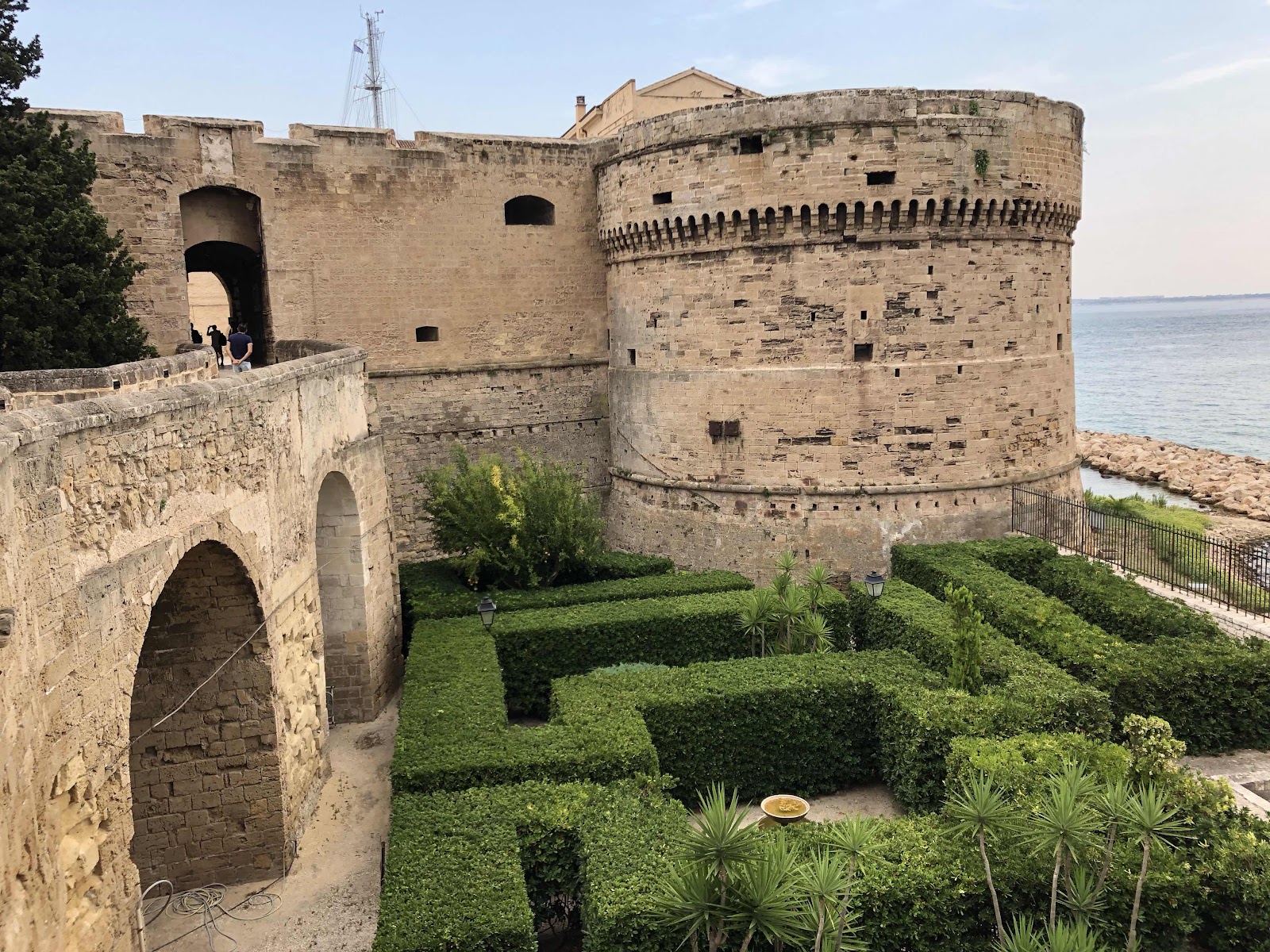
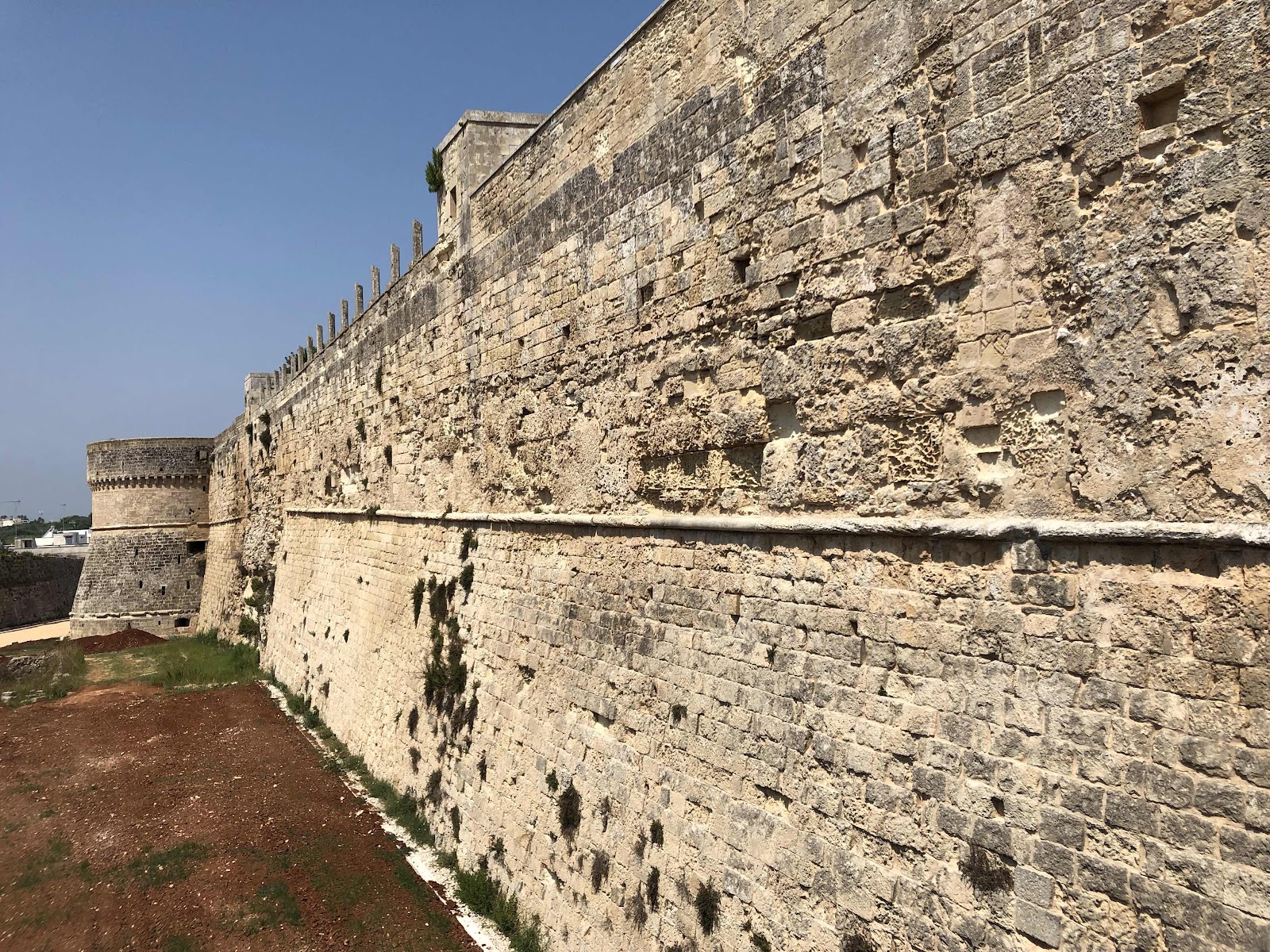
Castello St. Angelo, 1492. Castle walls are 25 feet thick to withstand 15th century Saracen naval artillery


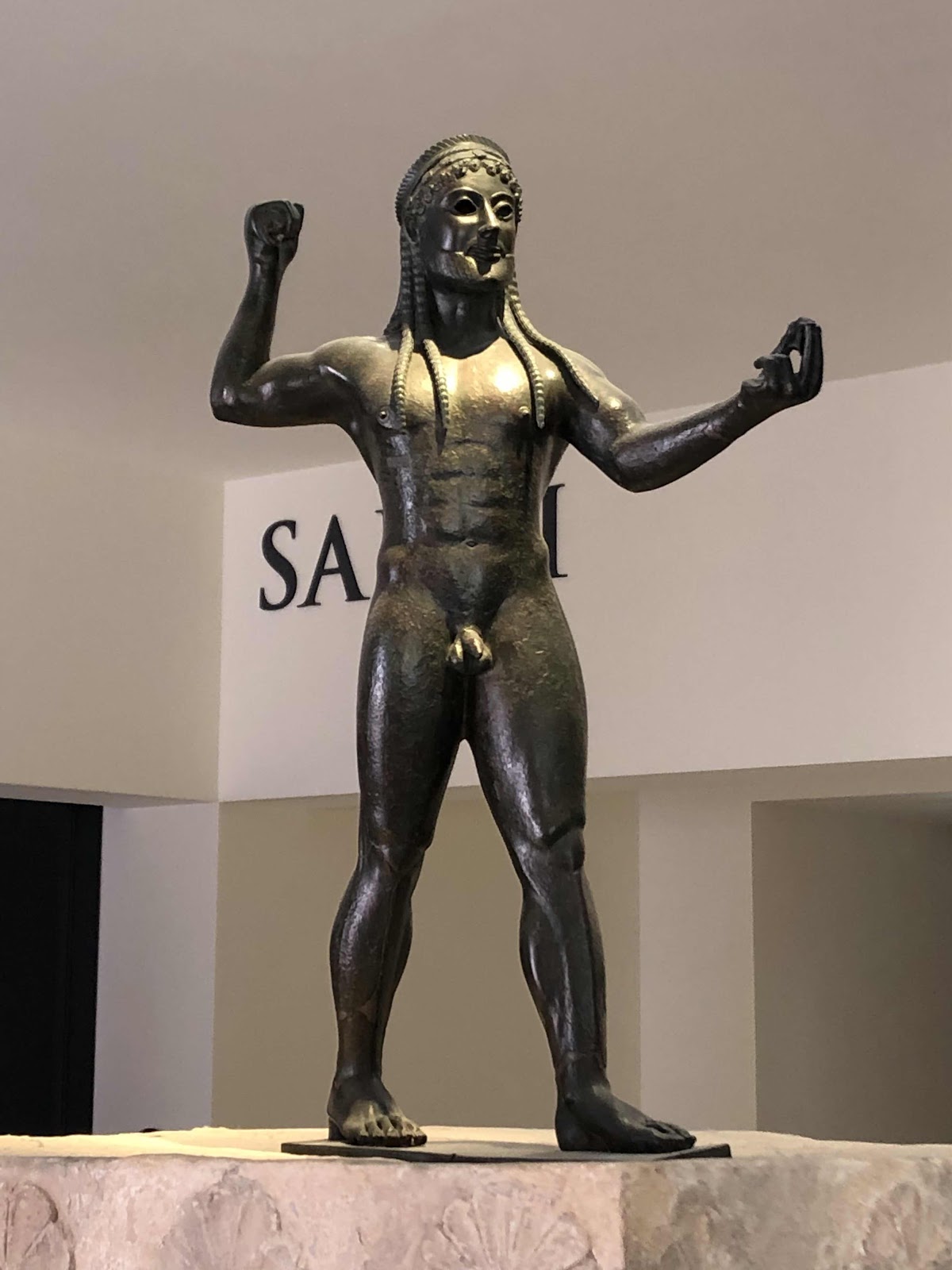
Zeus, from Greek settlement of Taranto, 5th - 6th century BCE


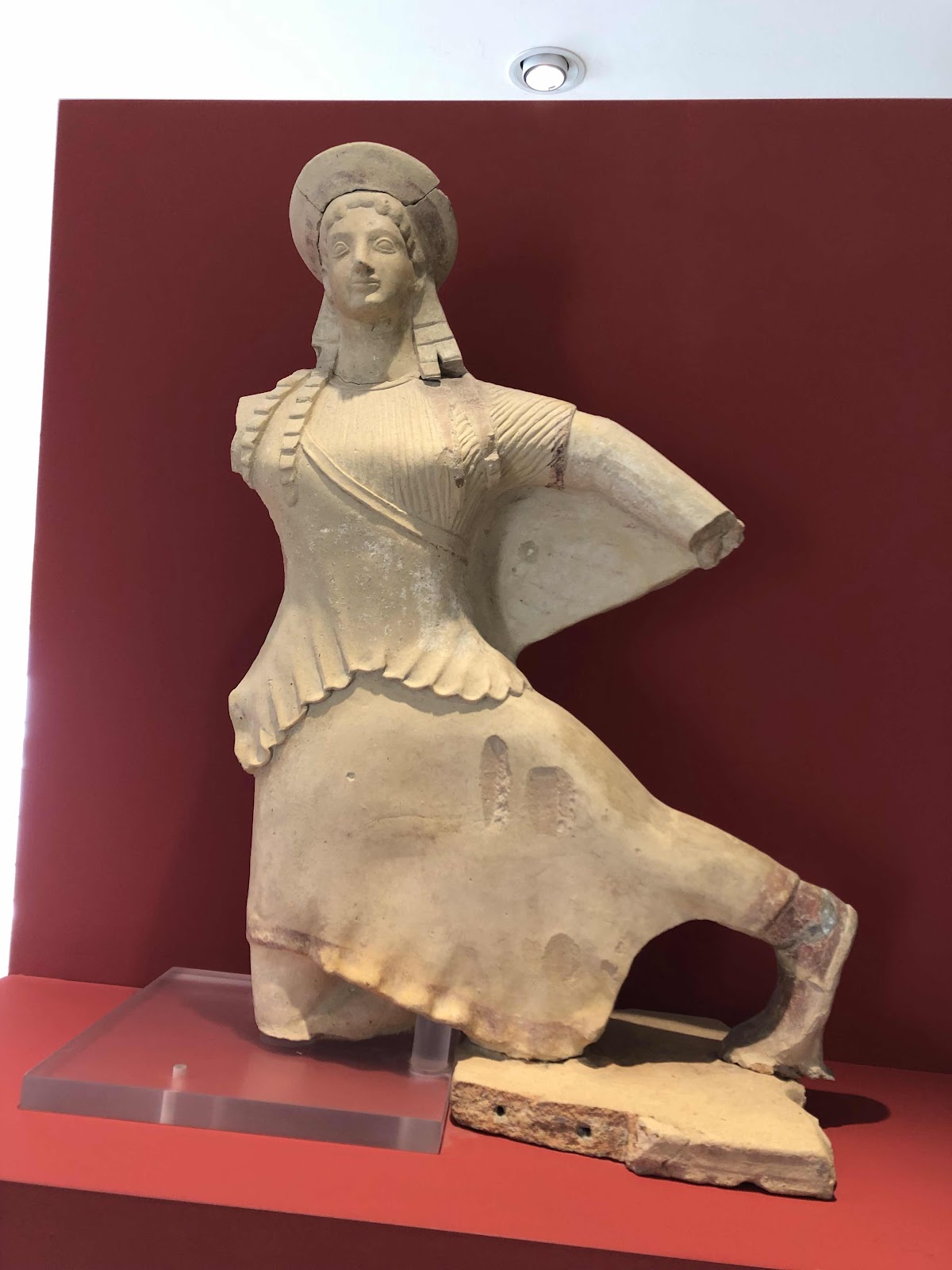
Greek sculpture, architectural detail, 5th century BCE


Greco Roman Battle scene sculpture, 3rd century BCE


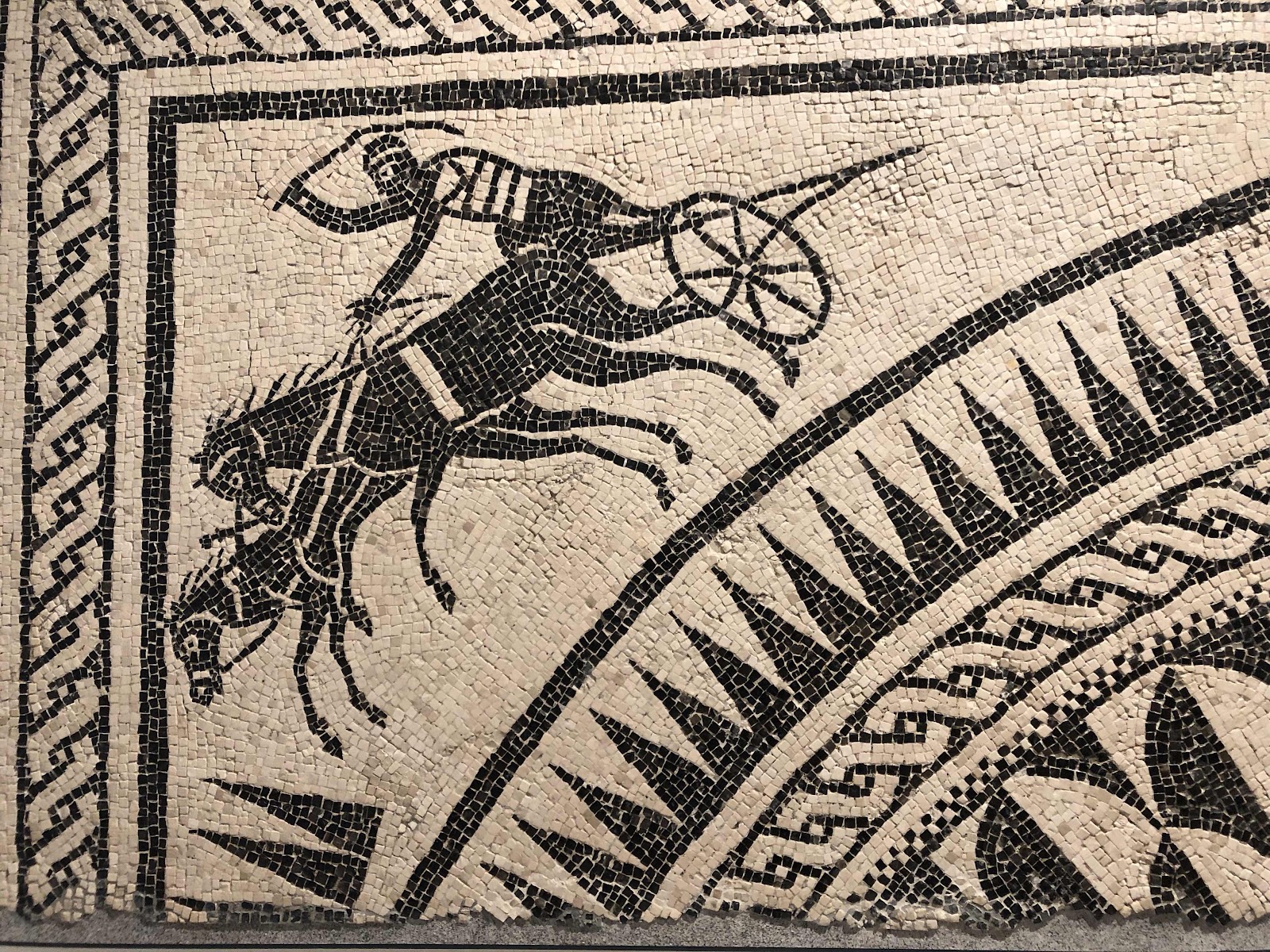
Roman floor mosaics, 1st / 2nd century BCE


The “modern” Taranto, 18th /19th century Taranto, Piazza Maria Immaculata

Ciao,
David


Sunday, August 25, 2019

Addio Lecce


Our week long Italian studies in Lecce have finished. Maria Rossini, our teacher, was good at ascertaining our weak areas, so the lessons were tailored well to our needs. We were a class of three...Virginia & me, and a Swiss girl, Larissa. Another class had several students who we got to know during the “pausa”, the 20 minute break in our 4 hour per day classes. It was a good group...students from Spain, France, Germany, U.K., and Belgium.
Our class with our teacher, Maria, and Larissa


Left to Right—front: Samir, Jean-François, Maria (Italian teacher)
Second row: Rachel, Larissa, Virginia, David, Juan, Margarita (Italian teacher), Angela


Enjoying caffè Leccese during the pausa


For the last two days we’ve been on the road in our rental car...a hybrid Toyota. So far so good; however I discovered that the car does not have a spare tire, we’ll try to get one tomorrow in Taranto, where we are staying for 2 nights. After we left Lecce, we visited Otranto, a city that straddles the Adriatic Sea and the Ionian Sea, only about 30 km from Lecce. As the other cities on the Salento Peninsula, Otranto was a part of Magna Grecia, that is, Greater Greece. It was a colony of Sparta...then a Roman City, and later under Byzantine rule, then Norman, etc., etc. there are some nice beaches with aqua-blue water,  and a harbor with both fishing and pleasure boats. On the top of a hill stands a castle built by Emperor Frederick II, later rebuilt by Alphonso II of Naples in 1485-98.
Otranto...the bay & the Castello Argonese


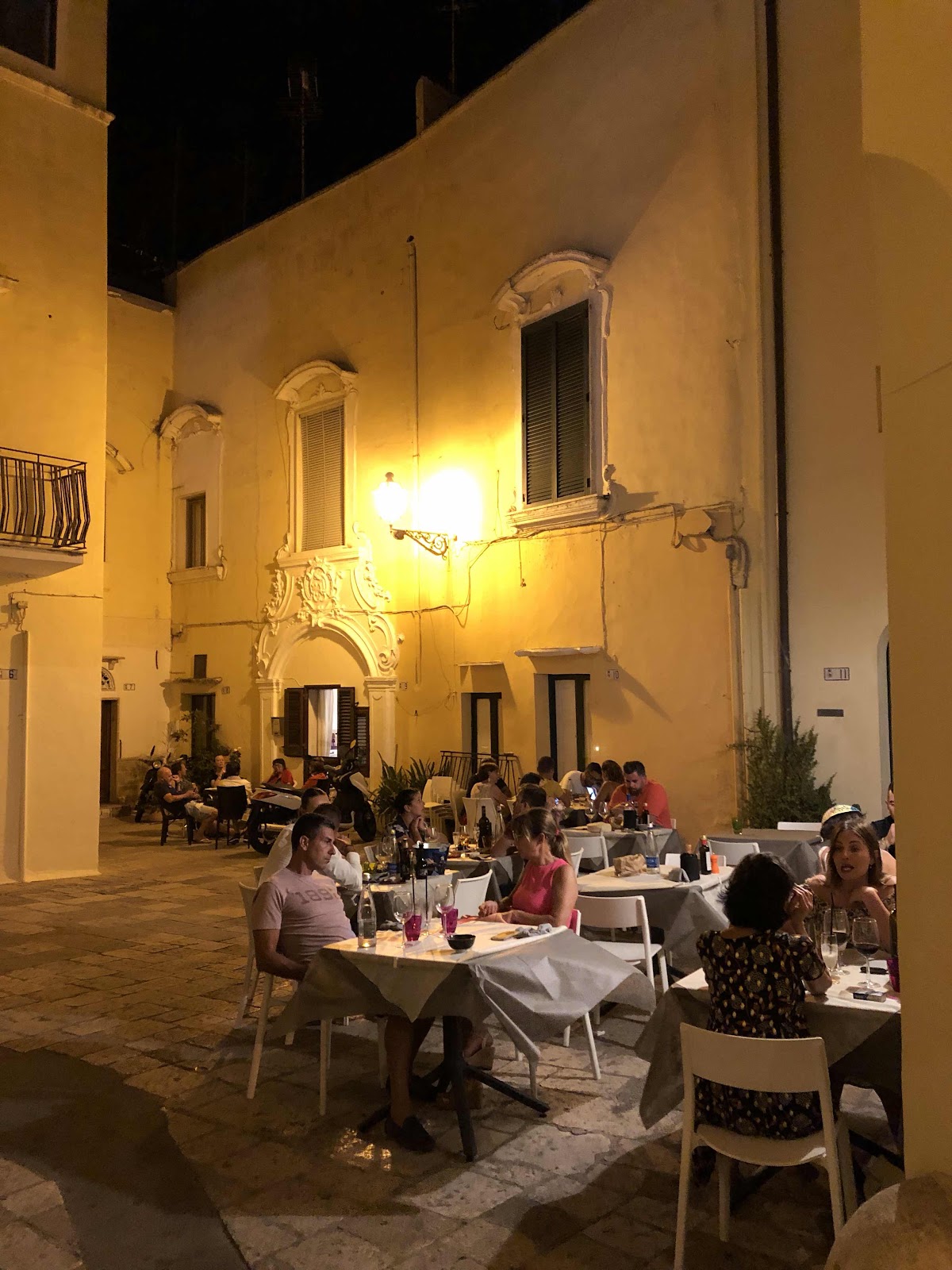
Our destination on Saturday, August 24 (yesterday) was Gallipoli. We arrived in the afternoon, checked into the Hotel, and we had a few hours of beach time. The old town of  Gallipoli is an island, with a very nice beach right along the center of town. It’s a very touristic town...the streets were crowded in the evening, with dozens of restaurants and shops open till past midnight. Fortunately we had a good tip on a restaurant, Osteria del Vico (suggested by Rocco, the fidanzato of Maria; he works at the farmacia around the corner from the restaurant). The menu was almost all seafood; we shared a primi, linguine alle vongole, and for the secondi, I had orata fish, and Virginia enjoyed spada, swordfish.

The beach at Gallipoli, and a few street scenes of Gallipoli


Saturday, August 17, 2019

In the Presence of the Madonna della Madia

When we arrived in Monopoli (one city) on Friday morning, we found the Puglia tourist info office right where we thought it should be...on the Piazza Vittorio, the main square. And it was open! One of the first things we learned was that in the evening there would be the annual procession of the ciry’s venerated Madonna, the Madonna della Madia. As we later learned, in 1107, the bishop of Monopoli was building a new church, Romanesque style, but they didn’t have the proper wood beams for the ceiling, and so the construction was delayed. Ten years later, in 1117, a Monopolitan, a lay person in the city, had a dream that the beams that were needed for the construction would be found in the port. Indeed, in a procession to the port, the bishop found a huge raft made of  the wood beams needed to build the new church ceiling. Moreover, on the raft, there was an icon of the Madonna and child. It seems as if Spanish was the lingua franca, because the Madonna was on the almadía, or the raft. So, in Italian, it is the Madonna della zattera, or keeping closer to the original Spanish, the Madonna della Madia.

We found the procession winding through the streets, with the Madonna della Madia carried on the shoulders of priests from the Chiesa della Madia in an hour long procession of Monopoli, which was decorated with lights on the Piazza Vittoria. 


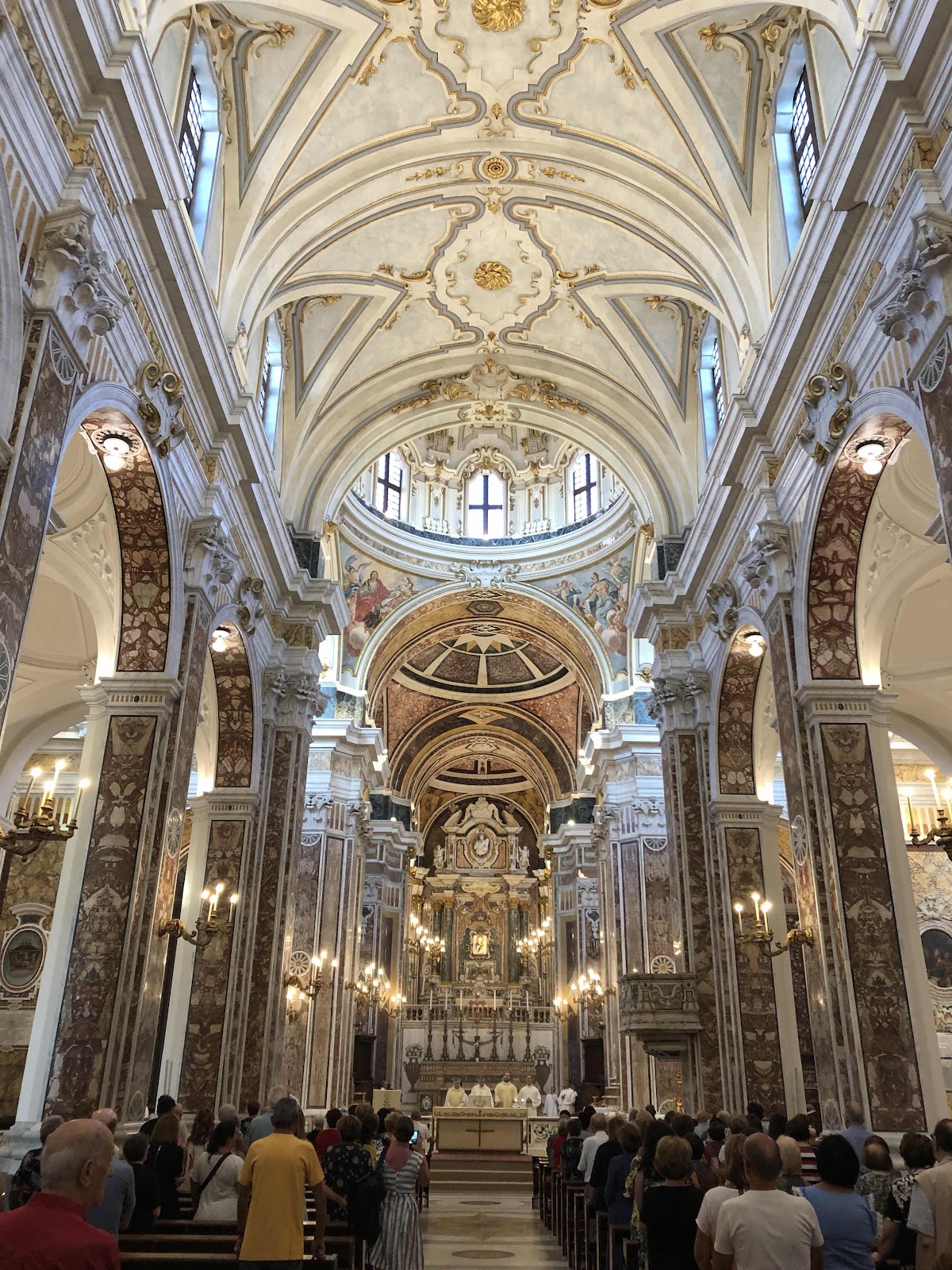
The original Romanesque church completely rebuilt in 1772 in a baroque style. The present day Cathedral, the Basilica of the Madonna della Madia looks like this:


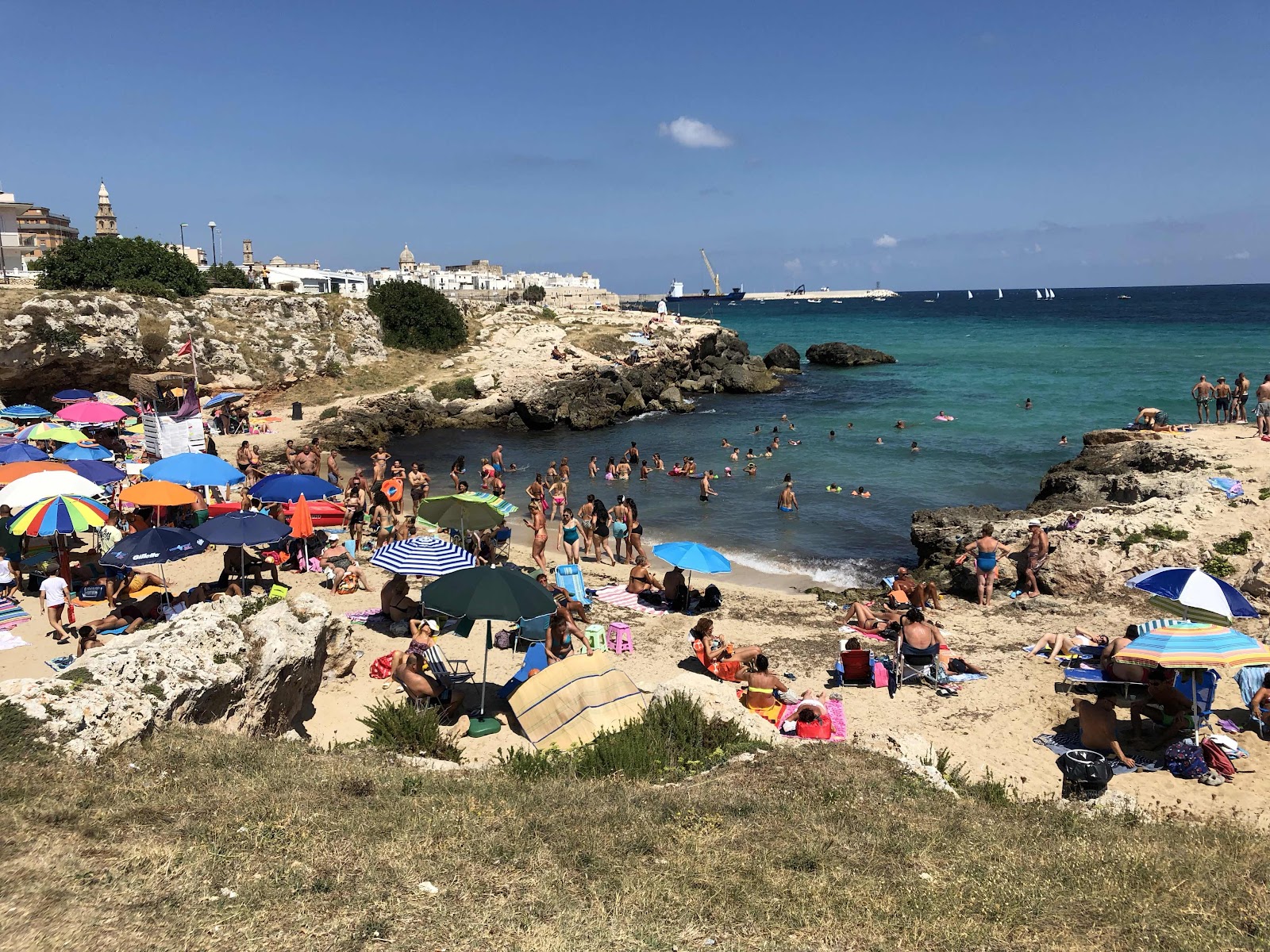
Today, Saturday was our beach day...we found a postage stamp size sand beach nearby...
       

Ciao,
David

Friday, August 16, 2019

The Sirens of Bari

The coastal cities on the Adriatic, Bari, Trani, Monopoli, etc. we’re all important during the Crusades as a way point to the Holy Land. Hence the fortifications of thes cities. Trani developed the first maritime code in 1063, the Ordinamenta consueto  maris; the City commemorated the 900th anniversary in 1963 with this basrelief.


It was during our last night in Bari, as we were taking a stroll through the narrow streets of the old town, that we heard, once again, the Siren Calls emanating from Maria’s Sgagliozze kitchen. I was lagging behind Virginia, when all of a sudden, I realized that she had figuratively gone aground amidst the treacherous rocks...and literally, the Sgagliozze of Maria. See the results for yourself.


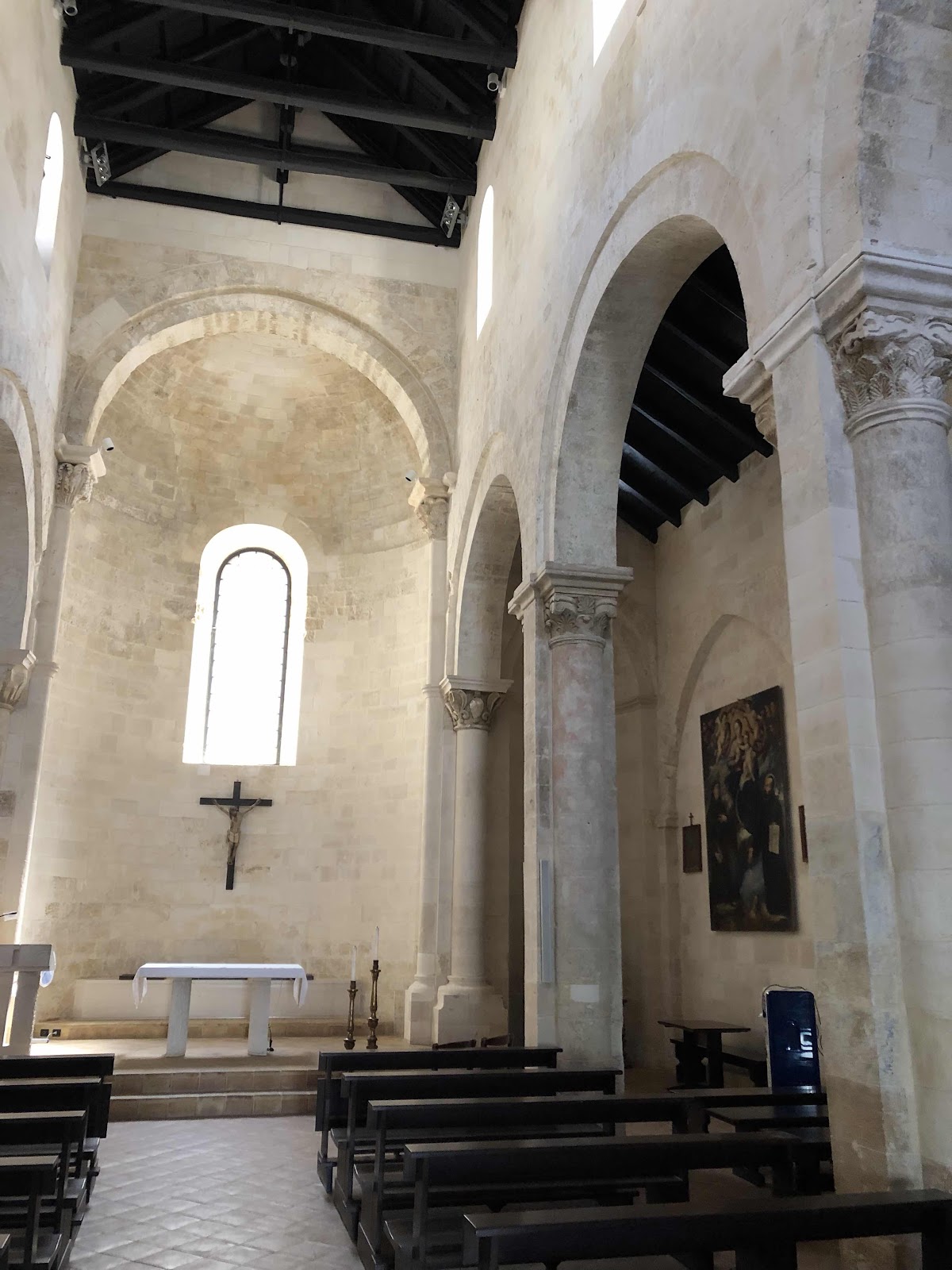
Our first few hours in Monopoli found us exploring the small streets near the main square, the Piazza Vittorio and Piazza Garibaldi. I’m always attracted to the simplicity if Romanesque churches, so we followed the signs to the Chiesa Amalfitana, built around 1060. From the outside, it didn't look Romanesque at all, more like a sixteenth century Renaissance facade. But the interior was definitely Romanesque; I was happy we made the detour.

The Renaissance facade belies the Romanesque origins of the Chiesa Santa Maria Amalfitana 


The interior of Santa Maria Amalfitana, Monopoli...decidedly Romanesque


The original church was carved out of rock in 1059 by people from Amalfi who were shipwrecked. Thankful for those who were saved, they built the church in honor of Maria.
 
Ciao,
David

Thursday, August 15, 2019

Two Cities, Two Castles

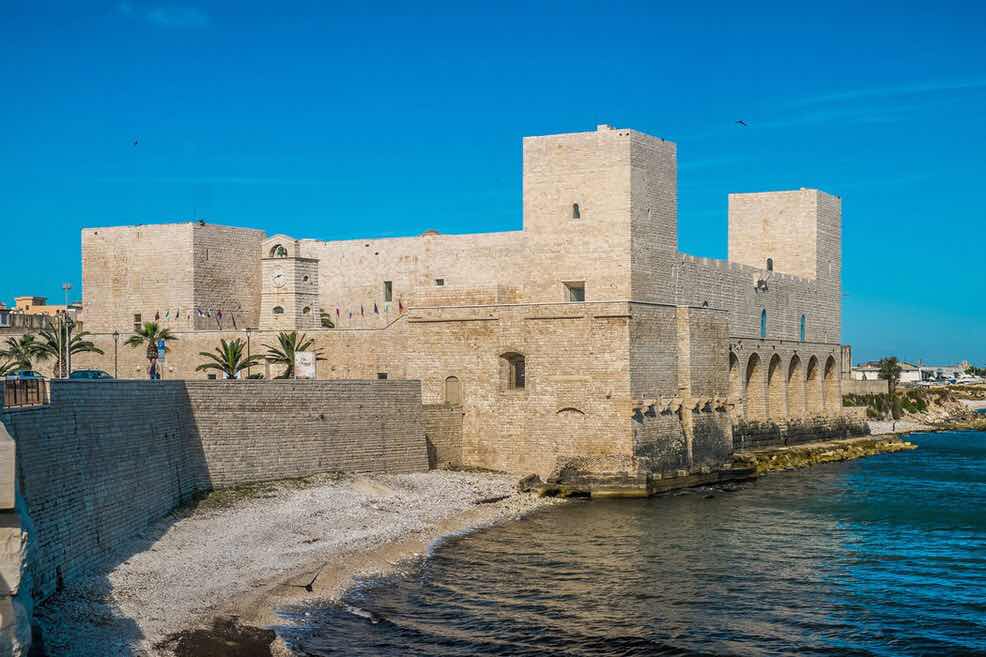
Two cities (Bari and Trani), two Norman (think Roger II) and Swabian/Holy Roman Emperor (think Federico II), and you have two castles. The Castello Normani/Svevo (Norman/Swabian) was built in 1132 by The Norman King, Roger II, and rebuilt by Federico II In 1233.

Castello Svevo, Bari

                           
Castello Svevo, Trani


Rumor has it that Emperor Federico II met St. Francis of Assisi at his castle in Bari in 1221. The emperor had a courtesan sent to Francis's room and watched through a peephole to see what would happen. When Francis sent the woman away, Frederick was impressed with his principles and they became friends. 

Who would have thought that I.M. Pei May have gotten some inspiration from the Castello Svevo in Trani in the design of the National Gallery of Art in Washington, D.C.? There is a striking resemblance between the two buildings, even though they are 600 years apart.

National Gallery of Art, I.M.Pei


But there’s more to these seaside cities on Italy’s Adriatic Coast than castles. For example, last night we took a walk around the narrow, winding streets of Bari’s old section (Vecchio Bari), and found the streets full of people at restaurants, gelaterias, and other small shops. But we were most delighted to see house owners in these narrow streets sitting by their open doors watching the parade of people walking by. Often there were people inside having dinner in their dining rooms that opened right on the street, or in other houses, it was their living room that was open to the street; one kind of felt like a voyeur, even if you were simply walking by and minding our own business. 

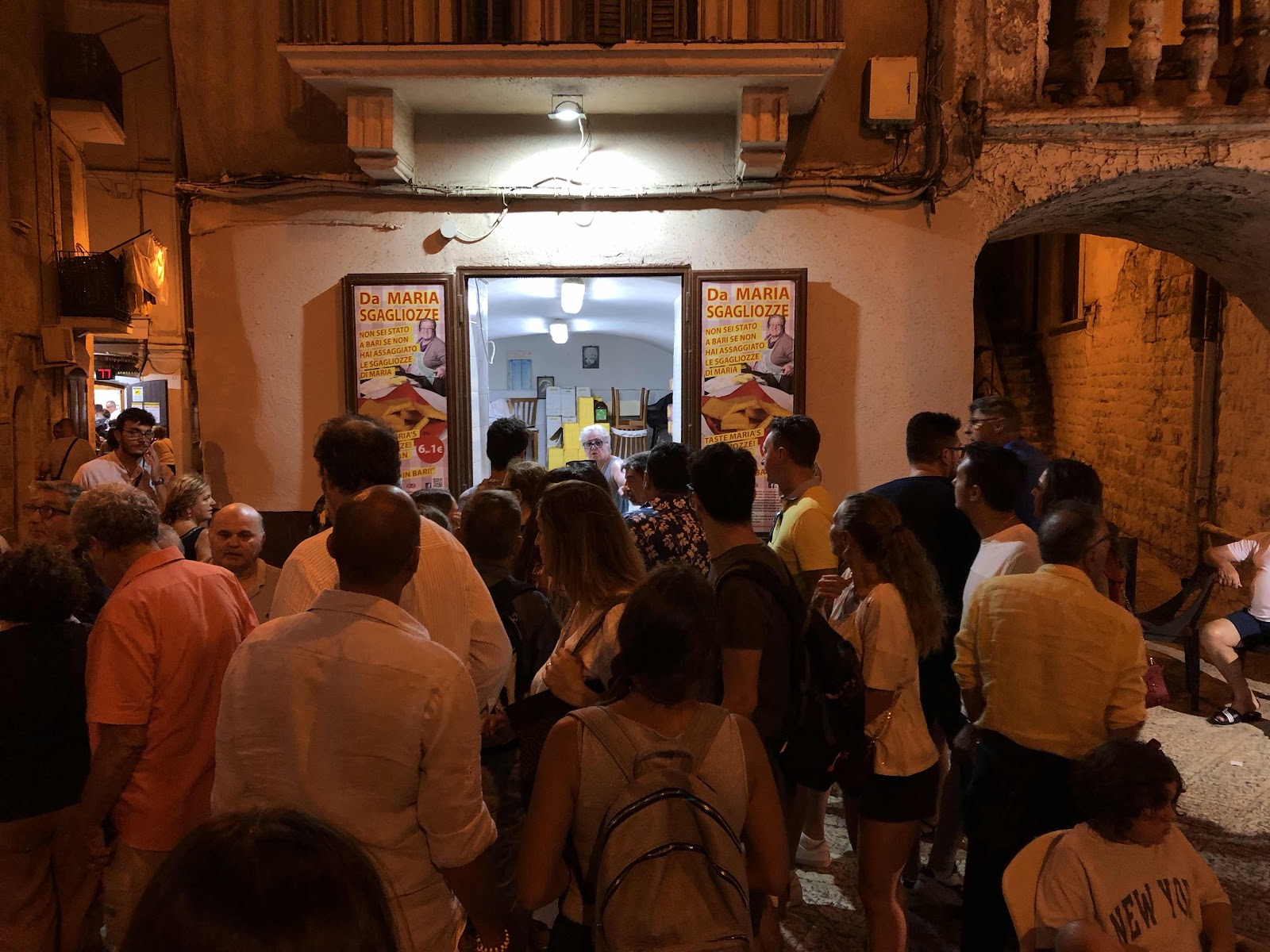
This hole in the wall place, Da Maria Sgagliozze, attracted a crowd of people waiting their turn to try Maria’s sgagliozze; it’s
 a speciality of Bari, especially popular during festivals (hey, Ferragosto is being celebrated in Italy right now!). Sgagliozze is basically fried polenta;  we didn’t try it here, but it’s kind of similar to panella, which is fried chick pea squares, a speciality of Sicily.

Maria’s Sgagliozze shop in old town, Bari


But we had a terrific dinner at Ristorante Giampaolo, not far from the Castello Svevo in Bari. We were too satisfied to even contemplate dessert, but perhaps because we were the only foreigners speaking Italian, they gave us a complimentary dessert...pastry filled with creme patisserie (like a custard cream). They were small...a few bites and that was it. We didn’t know what it was called, so we asked. The answer...sporcamuso. I knew that “sporca” means dirty, a mess...and that “muso” means snout or muzzle. Sporcamuso is the local dialect word for this dolce because if you’re not careful, you’ll have some of the custard left around your mouth. 

Ciao,
David


Monday, August 12, 2019

Monopoli is a city, not a game

I think we have remembered to pack everything for our trip...but as I write this, I just remembered that I haven’t checked my camera...to charge the batteries, see if I have enough memory cards, and test to make sure it’s working well. About a year ago I downsized; my travel camera is now a Sony RX100 III. The camera is about the size of just the battery charger for my Canon 5D Mk II, and it weighs about 1 pound 4 ounces instead of about 5 pounds for the Canon. So far I’ve gotten very good results, so I’m sticking with the Sony for traveling.

Our itinerary is finally complete. For the first few days we’ll be on the Adriatic coast...Bari and Monopoli (no, it doesn’t mean monopoly; in Italian that would be monopolio). The main attraction will be Lecce, where we are enrolled in the Scuola Mondo Italia for one week of Italian studies. And for the first time, we have signed up for the “Homestay”, kind of a B&B arrangement (we think). The Scuola founder and main teacher let’s out part of the apartment to students enrolled in Italian classes. The idea is that we will have extra opportunities to be immersed in Italian...everyday living Italian, not just textbook Italian with the normal 4 hour/day lessons. There’s a good likelihood that I’ll finally remember the difference between tovagliolo (napkin) and tovaglia (tablecloth). And why would one be masculine and the other feminine?

We’ll rent a car in Lecce at the end of our Italian language program, then drive Gallipoli, with a few other places in between. Note, this is not the Gallipoli where WWI naval and ground battles were fought between western allies and Ottoman Turks, where each side had about 250,000 casualties, of which about 100,000 died. Instead, this Gallipoli on the Salentina Peninsula, close to the tip of the heel of the Italian “boot”. Think fishing and tourism, not a horrific WWI battle site.


Potenza


Potenza

The other towns we visit will be mostly in Basilicata, which borders Puglia to the west (inland). We’ll go to aMetaponto (also on the sea), Alberobello (where we’ll find ancient houses with conical, stone roofs), Matera (famous for the Sassi cave dwellings carved into the mountainside). The old town and the Sassi is a UNESCO World Heritage site, is the European Capital of Culture in 2019. Another city that we’ll visit os Potenza, the Capital of Basilicata. It was heavily bombed during WWII, but as you can see from the photos, there are Roman ruins and an old city built on a Hill.


Wednesday, August 7, 2019

Pre-trip musings

Puglia and Basilicata

We’ll be leaving for our summer 2019 trip to France and Italy next week; here’s a preview of our trip.  We fly from Washington, D.C. to Paris on August 13, and then on to Bari, in Puglia, which is along the Adriatic coast. After a few days on the coast, we go to Lecce, near the bottom of the “heel” of Italy’s boot shaped country. This is where we will spend a week, enrolled in Italian classes.

For some reason, Lecce is called the Florence of the south; I don’t yet know why, because Lecce is celebrated for it’s Baroque architecture, whereas Florence is largely a Medieval and Renaissance City. If I find out why Lecce has this moniker, I’ll let you know. Here is an  example of the Baroque in Lecce.

Basilica di Santa Croce 

The Baroque in Lecce is said to be florid and exuberant; I clearly see that in Santa Croce. It is also said to be compact and neat, which seems to be just the opposite of florid and exuberant. I’ll have to see for myself. In any case, Lecce has an abundance of malleable, golden limestone, we’ll suited for architectural carving and sculpture. A certain Bishop Pappacoda and the architect, Giuseppe Zimbalo teamed up around 1639, and thus was born the Baroque in Lecce.

Lecce was conquered by the Romans in the 2nd century BCE, and in the 3rd century, a 25,000 seat amphitheater was built by the Romans.

Roman amphitheater...partially covered by newer buildings 


The fall of the Western Roman Empire was followed by the Gothic Wars, then in 549 the area was back under the control of the Eastern/Byzantine Roman rule for five centuries, with incursions by the Saracens, Lombards, Hungarians, and others. From 1053 to 1463...with the Norman conquest and rule by the Holy Roman Empire (which was neither Roman nor Holy), it was part of the Ki glom of Sicily. Then there was rule by the Ottoman Turks until they were defeated in a  avail battle, the Battle of Lepanto in 1571. 

And we haven’t even mentioned the fact that Hannibal, in 216 BCE, defeated a Roman army of 60,000 to 100,000 in Cannae, Puglia (north of Bari) by brilliant tactics. Fifty thousand Roman soldiers were killed vs. 6,000 of the Carthaginians forces. Hannibal May have been able to bring down the Roman Empire at that time if he had invaded Rome. Instead, 14 years later the Romans definitively routed the Carthaginians and razed Carthage. 

Enough for today...more on the rest of our travel itinerary in Puglia and Basilicata in the next post.

Ciao,
David